
The Part of hEDS Nobody Explains — and the Tissue Researchers Are Only Now Measuring
Flexible since childhood, then stiff, sore and exhausted for decades afterwards — with every test coming back normal. A small group of researchers now think one tissue accounts for more of it than anyone realised, and it isn't the ligaments, and it isn't in your head.
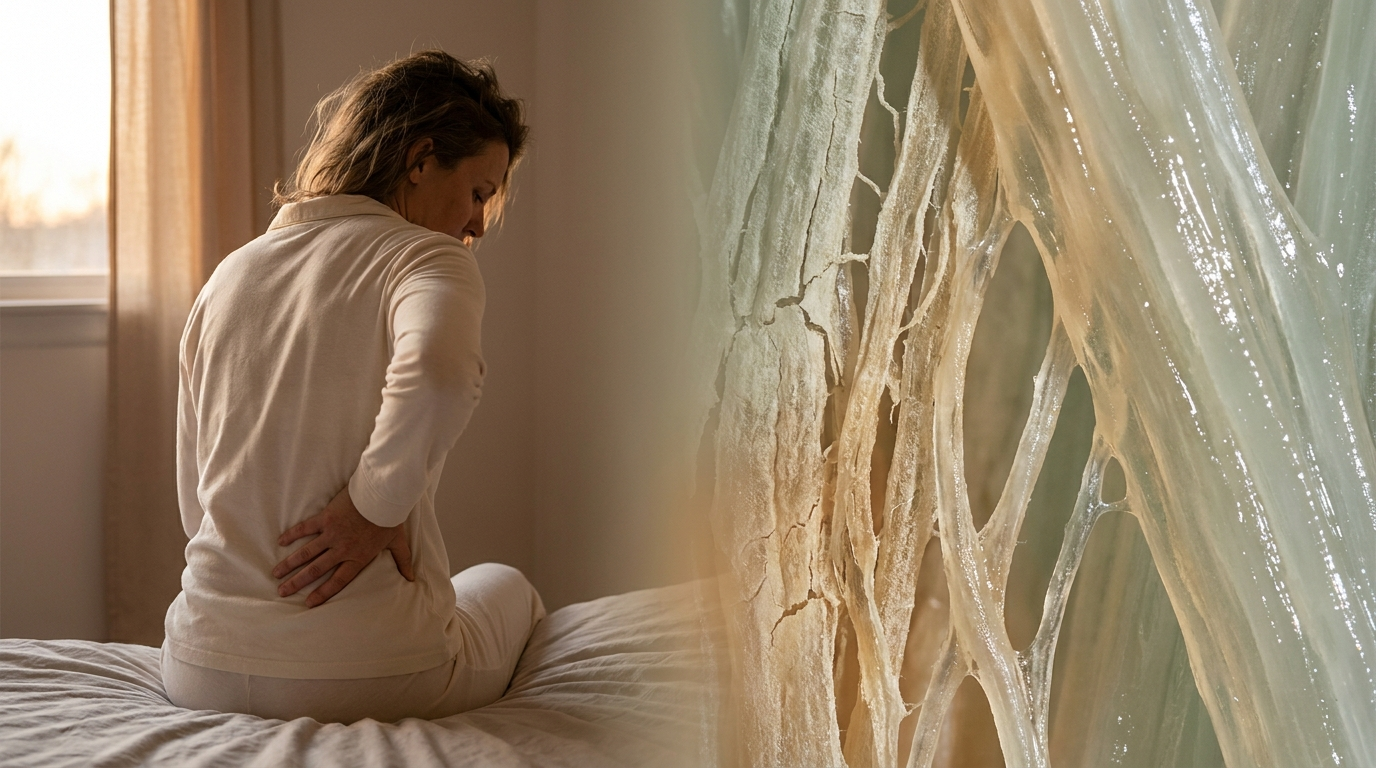
She can put her palms flat on the floor. She has been able to since she was nine. It was a party trick at school, and then it was the reason a physio said she would be fine, and then it was the reason three different doctors decided there was nothing structurally wrong with her.
What none of them could explain is why a body that bends that far also feels like it has set — the neck that catches when she checks a blind spot, the hips that ache after twenty minutes in a chair, the first hour of every morning spent negotiating with her own back.
Or why she wakes up tired. Eight hours of sleep behind her and she is already running on something borrowed, quietly working out which parts of the day she is going to drop before it has properly started.
Somewhere in her fifties it got worse, and she was told menopause, and that was true enough to end the conversation.
Her mother had "bad knees" and gave up walking any real distance by sixty. Before that there was a grandmother who was "double-jointed" and "just delicate," decades before anyone had a name for it. Three generations of the same body, handed three different versions of the same non-answer.
Were you the bendy one?
Not now — then. As a child.
Could you put your palms flat on the floor without bending your knees? Bend your thumb back towards your wrist? Sit in positions that made other people wince? Was there a party trick — the elbow that went the wrong way, the shoulder you could pop out on request, the splits you could do without warming up?
Were you praised for it? Most women who can answer yes to this were. It was flexibility, it was a talent, and in fifty years nobody has ever suggested it was a sign of anything.
The list nobody read out to you
These are features clinicians look for when they assess someone for symptomatic hypermobility. Read them as a life, not a symptom list — most of it happened decades ago.
- You could put your palms flat on the floor, or bend a thumb to your forearm, or straighten your elbows past straight
- You turned ankles on flat ground, more than once, and it was put down to being clumsy
- You had "growing pains" as a child, and they were described as normal
- You bruise easily, and often can't account for where a bruise came from
- Your skin scars badly, or scars spread and go white over time
- You got stretch marks that were blamed on the pregnancies, or appeared without one
- Something has dislocated or half-slipped out while you were doing nothing much at all
- Your mother had "bad knees." Your grandmother was "just delicate." Nobody was ever told why
- You've been tested repeatedly and everything comes back normal
- Somewhere along the way you were offered anxiety, or fibromyalgia, or your age, and none of them accounted for all of it
If a lot of that reads like a description of your life rather than a checklist, the condition doctors are describing is called hypermobile Ehlers-Danlos syndrome, or hypermobility spectrum disorder — and the reason you have probably never heard of it is at the bottom of this page.
"She listed her symptoms and the lightbulb moment happened. She was talking about me!"
— Judith, who recognised herself in a stranger's post and was diagnosed at 50
Why the flexible body is also the exhausted one
Here is the part that makes the tiredness make sense, and it is the piece that almost never gets explained.
Ligaments are the stops at the end of a joint's range. They hold the joint in place without any effort from you — you have never once thought about keeping your knee in its socket, because your ligaments did it for free.
If those stops are slack, the job doesn't disappear. It gets handed to your muscles.
Muscles are not built for that. They are built to move you and then rest. Stabilising a joint is a background task they have to run continuously — standing, sitting, driving, sleeping — and in a hypermobile body they have been running it since you were nine years old.
"Holding joints together is a real drain on energy."
— a patient, explaining her own fatigue on a forum, unprompted
That is not a metaphor. It is a continuous, unpaid energy cost that nobody has ever put on your account. It is why you can sleep eight hours and start the day at empty, and why sitting upright for an hour takes something out of you that it does not take out of other people.
It also explains the contradiction you have never been able to say out loud without sounding ridiculous: you are the most flexible person in the room and the stiffest.
Two different measurements. Joint range and tissue glide are not the same thing. Loose ligaments are why the joint travels too far. The tissue wrapped around and between your muscles is a separate layer — and that is the one people mean when they say their body feels like concrete.
Why it got worse in your fifties
Almost every woman who finds this can name the point it changed, usually to within a year or two. For a great many, it was somewhere around fifty.
"Lifelong issues that increased in severity and number over the years. The snowball really took off after menopause."
— a woman in her fifties, posting in a patient forum
The hormone story here is real and no honest article would wave it away. Oestrogen is involved in how the body builds and maintains collagen — the protein ligaments, tendons and skin are made from. As it falls, connective tissue across the body becomes a little less supportive than it was.
For most women that shows up as stiffer mornings and slower recovery, and it settles. In a smaller group it arrives like a demolition: joints get worse, the tiredness becomes something else entirely, and nothing settles. Those women get told what everyone else gets told, and are left to conclude privately that they are handling the change badly.
Menopause is a fair explanation for some of it. It is not an explanation for the ankles you have been turning since you were nine.
The layer researchers have only just started measuring
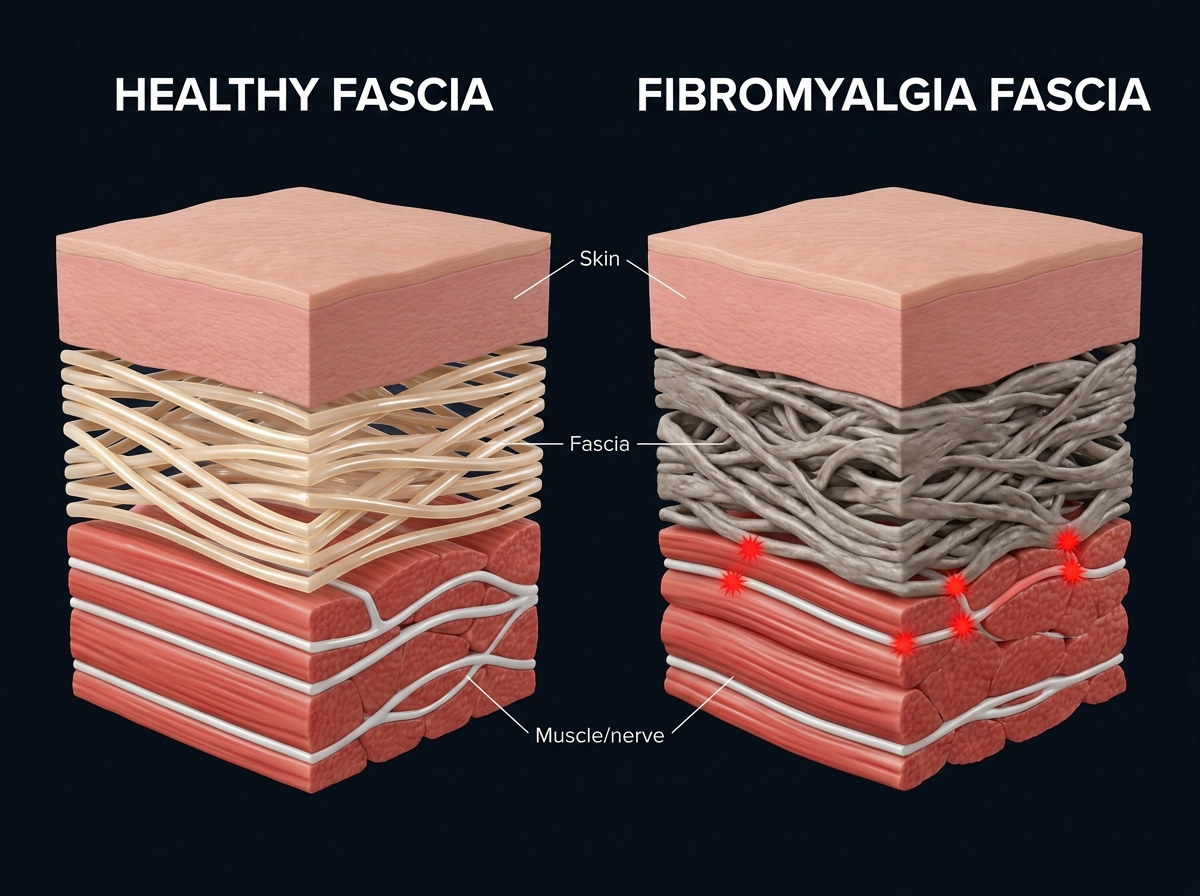
Wrapped around every muscle in your body is a thin, water-rich tissue called fascia. For most of the last century medical schools treated it as packing material — the cling film holding your insides in place — and it was routinely cut away and discarded in dissection.
In the last five years a small number of groups have pointed ultrasound at the fascia of hypermobile people specifically. It does not behave like everyone else's.
Thicker neck fascia in women with hEDS
Researchers used ultrasound to compare 27 women with hEDS against 39 people without it. In the deep fascia of the neck, the hEDS group measured 1.8mm thick against 1.5mm in people who had ordinary neck pain. Stiffness behaved differently in the two groups as well.
Source: Wang & Stecco, American Journal of Medical Genetics Part C, 2021
The layers slide less than half as well
A second ultrasound study measured how freely the layers of fascia down the outside of the thigh slide against each other. In people without pain, the layers moved 121% on that measure. Leg pain without hEDS dropped it to 89.5%. The hEDS group came in at 46.2% — tissue that should glide, behaving as though it is stuck.
Source: Journal of Ultrasound, 2023 — note: only 9 people with hEDS were examined. This is a small, early finding, and we are not going to present it as more than that.
Moving through tissue that does not slide costs more energy than moving through tissue that does. Researchers describe the difference as walking through wet sand rather than on firm ground — all day, every day, on top of the muscle work your ligaments should have been doing.
Why hasn't a scan shown this?
A fair question, and worth answering properly rather than skating past it. There is no blood test for hEDS and no gene has been identified for it, which is why diagnosis is clinical in the first place. And standard MRI and X-ray are built to find damage — tears, degeneration, inflammation. Dense, poorly-gliding fascia is not damaged tissue. Seeing it takes ultrasound elastography, which measures how tissue deforms, and that is not standard equipment in most rheumatology clinics yet.
A clean scan was never evidence that nothing was wrong. It was evidence that nothing the scan was built to find was wrong.
The things you already tried
By the time most women read something like this, they have assembled a private ledger of everything that was suggested and what came of it.
| Tried | What happened |
|---|---|
| Stretching, yoga, Pilates | Felt wonderful for an hour. Then looser joints and a worse week |
| Physiotherapy | Built strength, helped for six weeks, never touched the tightness or the fatigue |
| Deep tissue massage | Too aggressive for the tissue. Flared for days afterwards |
| Anti-inflammatories | Took the edge off the worst days. Nothing underneath changed |
| Iron, B12, thyroid panel | All normal. Still exhausted |
| HRT | Helped the hot flushes for many women. The joints and the tiredness carried on |
Why the stretching backfired. Stretching pulls at the joint, which already travels further than it should, rather than at the tissue around it. It is why the relief lasts about an hour and the instability afterwards lasts days. It is also why physiotherapists who specialise in hypermobility spend most of their time asking people to stop — and why nobody told you, because nobody knew you were hypermobile.
None of that is a story about a woman who did not try hard enough. It is what happens when you throw everything you have at a problem nobody had correctly named.
Twenty-two years, and nobody asked the question
An average 22-year wait for a diagnosis
An international survey of 3,906 adults — 3,360 of them with hEDS — found symptoms typically began at age 9 and a diagnosis typically arrived at age 31: an average delay of 22.1 years. Those diagnosed were living with an average of 24 other conditions, including chronic pain (98.9%), gut problems (84.3%) and dizziness or heart-rate problems on standing (71.4%).
Source: Journal of Clinical Medicine, 2025
Read those two ages again: nine and thirty-one. That is the average for people who eventually got diagnosed at all — and the survey is dominated by younger adults, because they are the ones being assessed now.
Nobody has been counting the women who are now sixty-five. They were children in the 1960s. The diagnostic criteria for hEDS were not written until 2017. There was no test to fail and no name to be given, so there is a whole generation of women carrying this who were simply told, decade by decade, that they were flexible, then clumsy, then anxious, then old.
Why it runs in families
Hypermobile EDS passes directly from parent to child — each child of an affected parent has roughly a 50% chance of inheriting it. Which is why the family history so often reads like a list of people who were never diagnosed: the mother with bad knees, the aunt with the weak stomach, the grandmother who was just delicate.
It is also why a great many women find this in middle age not because of their own symptoms, but because a daughter or a granddaughter got an answer first — and the criteria read like a description of them.
"My daughter is more affected than I am and she was diagnosed at age 16. Then her doctor started asking me questions and told me I had it too."
— a woman diagnosed at 48, in a patient forum
If you recognise yourself in this page, the most useful thing you may do with it has nothing to do with buying anything: show it to your daughter. The party trick at the dinner table is worth a conversation now rather than in forty years.
Why hasn't anyone told you this?
The honest answer is duller than a conspiracy. Fascia research is genuinely new. Imaging this tissue in living people has only been possible for about a decade, the hypermobility-specific work is newer still, and most doctors practising today trained before any of it existed. The 2017 criteria arrived when you were already in your fifties.
There is also a quiet financial asymmetry worth naming. A hydration-supporting supplement cannot be patented, so no pharmaceutical marketing budget is pushing this in front of you the way one would for a new prescription drug. Nobody is hiding it from you — and nobody is promoting it either.
Read the studies yourself
Everything cited above is published research. Tap any study to read it in full.
Fascial thickness and stiffness in hypermobile Ehlers-Danlos syndromeAmerican Journal of Medical Genetics Part C, 2021 — 27 hEDS subjects, 39 controls Change in gliding properties of the iliotibial tract in hypermobile Ehlers-Danlos syndromeJournal of Ultrasound, 2023 — 9 hEDS subjects. A small, early study Defining the chronic complexities of hEDS and HSD: a global surveyJournal of Clinical Medicine, 2025 — 3,906 participantsLinks open the original studies on PubMed, the US National Library of Medicine's research database. This research is about fascia and hypermobility in general. None of it is research on Aurelia.
Before we tell you what we make, here is what we are not going to claim
You will find supplements online claiming to be "formulated for the tissue changes documented in hEDS," or to address "the root cause." We are not going to say that, because the research does not say it yet. Specifically:
- Aurelia is not a treatment for hEDS, hypermobility, or menopause. It is a dietary supplement. It does not treat, manage, reverse or target any of them.
- Nothing in this formula changes your collagen, your genetics or your joints. Loose ligaments stay loose. That was never the part anyone could offer to fix, and anyone telling you otherwise is selling you something worse than we are.
- None of our ingredients have been studied in people with hEDS. Not one. The research above is about the tissue, not about this formula.
- Whether the fascia changes cause the symptoms or result from them is still an open question. The studies show a difference. They do not yet show which came first, and the gliding study looked at nine people.
- We are not claiming fascia explains the migraines, the gut or the dizziness. Those are documented parts of the same picture, but the research points elsewhere for them.
What we can tell you is what Aurelia is formulated to support generally — and then let you and a doctor decide whether it belongs anywhere near your routine.
What Aurelia is formulated to support
Aurelia is a fascia and connective-tissue support formula. It is built around compounds that recur in the wider fascia literature as relevant to how much water connective tissue holds and how easily it moves — in the general population, not in hypermobile people specifically.
High-molecular-weight Hyaluronic Acid
The molecule fascia relies on to hold water inside itself — a single gram can bind over a litre. Most joint supplements use the low-molecular-weight form, which absorbs faster but holds far less; this is the heavier, slower-release form found in fascial tissue itself.
Bioavailable Silica (bamboo-derived)
The mineral associated with connective tissue elasticity — what lets tissue stretch under load and recover afterwards rather than staying rigid.
Serrapeptase
A natural enzyme studied for its role in breaking down hardened tissue buildup, rather than only lubricating around it.
Magnesium glycinate
Included at a meaningful dose for its role in muscle relaxation and sleep quality. In a body whose muscles are doing stabilising work around the clock, this is the ingredient most directly aimed at the part of the picture our customers report noticing first.
Boswellia serrata & bromelain
Studied for supporting the body's normal inflammatory response at tissue level, without the stomach burden associated with long-term painkiller use.
Type III Collagen Peptides
The collagen type most concentrated in fascia, included as a source of the amino acids connective tissue is built from. To be explicit, because this community asks and deserves a straight answer: collagen peptides are digested into amino acids and cannot alter the collagen your body genetically produces. Nothing here changes hypermobility in either direction.
Gotu kola & curcumin
A supporting blend chosen for circulation and tissue-recovery support.

"I spent eleven months and seven formulation attempts getting the ratios right before I would put my name on it. My own patients were the first people to try it."
What ninety days looks like
The order matters more than the numbers, so read it in order. Sleep moves first. That is consistently the earliest thing our customers report, and for a woman whose loudest complaint is exhaustion it is the one worth watching for.
Based on a voluntary self-report survey of 900+ verified Aurelia customers. These were our general chronic-pain customers. They were not selected for, or asked about, hypermobility or an hEDS diagnosis. It is the only outcomes data we have, and we would rather label it honestly than imply it came from women like you. Not a clinical trial. Individual results vary — see the full disclaimer below.
Is it safe with what you are already taking?
Aurelia is formulated to sit alongside the medications commonly used across this picture — standard pain relief, HRT, migraine preventatives, the medications prescribed for dizziness on standing, and the antihistamines many people are on. There is no need to stop anything to start.
Two specific notes, because women in this group are often on more medications than average. If you take a blood thinner, take Aurelia at least two hours apart from it and clear it with your prescriber first, as serrapeptase and bromelain may affect clotting. And if you react to a lot of supplements or have mast cell issues, start with one capsule and tell your doctor what you are adding.
— Dr. Melissa Hartwell, DO
Real reviews, honestly labelled

Two different Aurelia customers — not a before and after of the same person.
The guarantee
Try Aurelia for a full ninety days. If you have not felt a meaningful difference, email us for a refund — keep the unused product, no return shipping, no restocking fee. The window matches our own data on purpose: ninety days is when you should know.
If you have spent forty years being told things by people who were very sure, we would rather be the ones who told you the limits first and made it easy to walk away.
Aurelia is made in small batches in an FDA-registered, GMP-certified facility in the United States, third-party tested for purity, and fully vegan with no fillers.

Common questions
- I'm sixty-eight. Isn't it too late to find out?No. Women are diagnosed in their sixties, seventies and eighties, and they describe the same relief as anyone else — because the value of a name is not only what you do about it. It is understanding what the last fifty years were. It also tells your daughters and granddaughters what to look for, which is the part that is genuinely time-sensitive.
- Is this a treatment for hEDS or hypermobility?No. Aurelia is a dietary supplement formulated to support fascia and connective tissue generally. It is not a treatment for hEDS, and no supplement is. Nothing here should replace care from a doctor who knows the condition.
- Have these ingredients been tested in people with hEDS?No. We would tell you if they had. The research above is about the tissue — it is not research on this formula, and we are not going to present it as though it were.
- Won't a collagen supplement make hypermobility worse?A reasonable question and worth raising with your doctor. Collagen peptides are broken down into amino acids when you digest them rather than used as intact collagen, so there is no known way they would make joints looser. Nobody has studied this formula in hypermobile people, so that is reasoning rather than data.
- I'm already on HRT. Does this replace it or interfere with it?Neither. Aurelia does nothing to your hormones and is not an alternative to HRT. If HRT is helping you, keep taking it and talk to your prescriber before adding anything.
- How is this different from a joint supplement?Most joint formulas target cartilage and lubrication at one joint. Aurelia is formulated for fascia — the connective tissue layer running through the whole body — which is why customers report whole-body changes rather than relief in one spot.
- How long until I notice something?Our data shows the earliest reported changes around week 4, usually sleep, building through weeks 8 to 12. It is gradual by nature. There is no overnight mechanism here, and we would be sceptical of any product claiming one.
- What if it doesn't work for me?You are covered by the ninety-day guarantee — full refund, no questions, keep the product.
P.S. — If you are the sort of person who reads the ingredient panel before anything else: good. Every dose and source above is exactly what is on our label. Nothing rounded up, nothing hidden behind a proprietary blend.
P.P.S. — If you have read this far and recognised your mother rather than yourself, or your daughter rather than either: send it to her. The conversation is worth having whether or not anybody buys anything, and the guarantee works the same way regardless of who places the order.
This article is sponsored content produced by Aurelia Secrets. It is advertising.